A History of Coke Making
Chapter 1-Year 2009
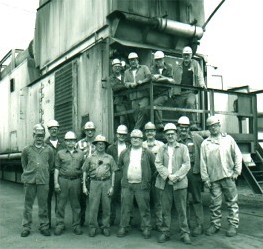 Each year in this column, we step back and reflect on our heritage, and the beginnings of coke making in Bethlehem. It has been said often enough that through all of your reading you probably know that the Coke Oven Division traces its German roots to 1910, with the formation of the Lehigh Coke Company. Its primary business was the production of metallurgical coke to feed the blast furnaces of local iron and steelmaking, most notably Bethlehem Steel, but it also produced coke oven gas and variety of coal chemicals that in that pre-petroleum era were the backbone of end products that were used both within and outside of the steel business. For example, coke oven gas was used for heating furnaces in the steel plant and for domestic consumption -- do any of you remember the Allentown - Bethlehem Gas Company, the predecessor of UGI? We supplied them with our gas through 1952. Coal chemicals went into fertilizers, road materials, dyes, explosives, and a host of products like nylon, plastics, and carpet fibers that were derived from our benezene, tolene, xylene, and naphthalene. With such a variety of processes going on, a historian can select numerous anniversary dates to talk about and celebrate, and in one way or another, all of you have made this history possible, either by operating the equipment, maintaining, or rebuilding it, or by supporting those who did with puchasing, sales, scheduling, and so forth. Since we have such a "young" group, it might be wise to pick a relatively recent bit of history to note an anniversary. 2006, marks the 30th anniversary of the start up of "A" Battery, which pushed its first coke on June 16, 1976. As you may remember, these were the first and only 6 meter ovens that operated in the Coke Oven Division. Now you may have a variety of emotions jump into your mind at the mention of "A" Battery. It certainly was big. The pusher weighed in excess of 400 tons, the ovens were 20 feet high, and when you dropped a door, it was a big deal. Each oven produced about 23 tons of coke from a charge of 35 tons of coal. Almost from the "get go," it developed refractory bulges in the oven chambers under the Larry rails, most memorably #29 oven, along with other problems, but through everyone's efforts, the problems were slowly coming under control. The final oven push on "the Big A" came at 1:00 a.m. on March 28, 1998, but our memories of it last a life time. Think about it, because if you do, you won't just think about bricks and mortar, but rather of the fabulous friendships you created. So enjoy these times together and keep the memories alive because the Coke Ovens were a special place to work and with a lot of extraordinary people.
The most important thing about our Reunions is that we celebrate together like the "family" that in a sense we are. No other part of Bethlehem Plant was quite like ours when it came to close knit relationships. For more than 86 years, cokemaking went hand-in-hand with friendship because there were times when we spent more together than with our own families. For the last nine years, we have come together to prove that our bonds are as strong as ever. There will never be another group of people quite like ..........The Coke Ovens - Our people make Us Special !!!!
Chapter 2-Year 2010
As has been said in these pages before, the year 2010, marks the Centennial Year of the formation of the Lehigh Coke Company, a subsidiary of Didier-March Company. Didier also lent its name to "Didier Gate" and to the little community that formed around the fledgling cokemaking operation whose roots goes back to February 4, 1910.
Charlie Schwab saw the benefits of by-product cokemaking in a trip to European 1908. Not only was coke used for blast furnace ironmaking, but the by-product gas fueled steel plants and the coal chemicals were prized commodities in that era before petroleum based chemicals production took center stage.
So in 1910, Charlie enticed two German companies - Stettiner Chamotte Fabrik Vorm, Didier and Berlin-Anhaltische Maschinenbau Aktien Gesellschaft- to partner and build 300 by-product coke ovens with funding provided by Deutsche Bank.
The first ovens experienced many refractory problems after cokemaking began in August 1912. and were replaced in the period 1914 - 1918 by 424 Heinrick Koppers ovens. Those of you that worked old #1 or #4 Batteries lived a part of that history, though refractory repairs were carried out on those batteries in the 1920's and 30's.
Eventually between 1941 and 1942, as World War II engulfed the world, #2 and #3 Batteries were rebuilt from the pad up with a new Koppers-Becker design, including four blocks of 51 ovens each.
#5 Battery - another Koppers design, pushed first coke on August 19, 1953, at the site of the original Didier batteries - the coal tank for #5 Battery was an original from 1912.
Finally with a long heat-up and hold period behind it, "A" Battery pushed its first coke in 1976.
There is a lot more to the story of our history. We'll go through a more detailed review of cokemaking at Bethlehem in our Reunion program.
Chapter 3-Year 2011
One hundred years ago in 1911, the construction of the ovens and associated equipment at the Lehigh Coke Company was well underway, and over the years in these pages, we have mentioned various companies by name, including those that were part of those early years and some that followed as new oven replaced the old. Who were these builders and where did they come from? Let us go down the list.
Stettiner Chamotte Fabrik Vorm Didier - Friedrich Didier founded Charmotte F. Didier in what was then Prussia in the town of Podejuch near Stettin in 1834, to produce refractory bricks needed in the new industrial age taking shape. Eventually, in 1908 the company in the form of Didier-March established a plant in Keasby, New Jersey, near Perth Amboy to make chemical industry stoneware and clay products. Didie-March as the name implies was connected to Stettiner Chamotte, which takes care of the refractories side of the new batteries yet to come at the Lehigh Coke Company in South Bethlehem. Notice that they produced clay products at Keasby - fire clay oven wall construction was eventually replaced by silica brick as cokemaking technology evolved.
Berlin-Anhaltische Maschinenbau Aktien Gesellschaft - Th Berlin based company ended up in South Bethlehem as a result of a 30 year cooperative operating agreement entered into in 1906, with the aforementioned Stettiner Chamotte Fabrik. As their name implies, they knew something about machinery and complemented the Stettiner Company during the construction of the plant. Even in the late 19th Century, the Germans thought the company name was a mouthful and instead called it by its initials - today you might also know it as Bamag, a company in a variety of businesses and based in Butzbach.
Heinrick Koppers GmbH. - The original four batteries of the Coke Company had operating issues and never reached the production levels expected - and needed - by the growing Steel Company. As a result this company arrived on the scene in 1914. Henrick Koppers himself started as an employee of Dr. C. Otto and Company (name sound familiar?) in Dahlhausen, Germany in 1894, and started his own company in Essen in 1901, eventually branching his firm into the United States in1907. In the periode 1914 - 1918, four batteries totaling 424 ovens of the Koppers design replaced the old Didier ovens. Old #1 and #4 Batteries that many of us "yougsters remember were remaining units from this era in the Lehigh Coke Plant's existence. Since I skipped mentioning #2 and #3 Batteries, you might ask what happened to them? In 1906, Joseph Becker started working for H. Koppersand later came to the United States to work with the American offspring of the Kopper's company. He created anew oven heating design, which was marketed as Koppers-Becker ovens, and in 1941 - 1942, Bethlehem purchased two batteries (204) ovens) of this "new" #2 and #3 Batteries that many of you operated.
Firma Carl Still - Yes, there was a Carl Still in Germant as well. He establihed his compamy in Recklinghausen in 1898. The company was particarly well known for its by-product plan designs and built ur Benzol Plant operations during 1915 - 1916. The liquor coolers, tar, and ammonium sulphate recoveery facilities of the By-Product Plant were already in place, built during the construction of the original batteries.
Dr. C. Otto - Although the Otto-designed "A" Battery didn't arrive on the scene until the mid 1970's, the company itself wasn founded by Dr. Carlos Otto in Dahlhausen, Germany in 1872. Many future battery builders came through this Company and eventually formed their own firms. Today the fim with this name is a refactory supplier, while the original coke oven builders of Otto, Koppers, Didier, Still, Wilputte, and others were eventually merged and adsorbed into the large German conglomerate, Thyssen Krupp and its engineering arm, Uhde.
When you review the list of all of the players involved with our Coke Oven Division over its 88 year operating history, you see multi-national, multi-cultural aspects that made the operation very special. From its beginnings as the Lehigh Coke Company in 1910 until the Coke Oven Division's closure in March 1998, we continued the tradition with employees that came from a variety of cultural and ethnic backgrounds - a close knit and very special place to work indeed.
Chapter 4-Year 2012
One hundred years ago in August 1912, the first four Lehigh Coke Company batteries of 75 ovens each went into service at our "home" in South Bethlehem. That battery was followed by two mpre 75 oven batteries by the end of the year, with the fourth and final one of the original construction coming on-line in 1913.
At that point 300 ovens were completed. They were arranged in a rectangular pattern, numbered in the directional order that you remember that we always used - except when "A" Battery was built in 1975 - north to southwest to west. thus old #1 and #2 Bateries were in the places later occupied by #3 nd "A" Bateries respectively, with old #3 and #4 Bateries to their south, old #4 being where later #5 Battery operated.
The original plan was to have block of 4 batteries (300 ovens) built to the east of the original four, in a similar rectangular pattern, presumably to be #5 through #8.
Bethlehem Steel was contracted to receive the metalurgical coke from the operation in exchange for supplying the coking coal to be used. The coke oven gas was under a separate contract with Bethlehem Steel with the excess gas being available to trade or for the City. As for the by-products recovered from the gas, they were solely under the control of Lehigh Coke Company. This later became an issue when World War broke out in Europe, as the Germans wanted to supply those by-products to the "Homeland" while Charlie Schwab and Bethlehem Steel wanted to retain the products for the Allies war effort
More on that later, but lets backtrack to the original Didier-March batteries for a moment. To those of you that read these pages nd the Reunion program each year, you'll recall that the original batteries were less successful due to refractory problems although the builders also cited the coalsupplied by Bethlehem Steel as the problem. The batteries were to be built with brick supplied from a new Didler-March plant in New Jersey, but a fire forced the builders to find other refactory suppliers to provide the necessary brick. Whereas all four of the batteries were operational by August 1912. This fire setback the construction schedule and quite probably led directly to the refactory problems later experienced. Ultimately, serious damage to the oven walls during their brief operating lifetime led to their demise, and Henrick Koppers was brought in by the Coke Company to construct four new batteries ("A", "B", "C", and "D"), totaling 424 ovens to be built between 1914 and 1918. By February 1917,it was clear that America was going to be embroilled in the European War, and the Coke Company sold the facility to Bethlehem Steel to avoid government confiscation under the Alien Property Act.
There is so much more to the story behind the brief existence of the Lehigh Coke Company and its operation, including the interesting peole that began cokemaking in South Bethlehem a century ago, But that's for another time.
Chapter 5-Years 2013
In last year's Coke Sacker, we described the construction of the first four batterie of the Lehigh Coke Company (totaling) that led to the start of cokemaking beginning in 1912. During our time at the Coke Ovens, we heard on numerous occasions those ovens (some abandoned foundations remained visible to the east of where 5 Battery sat) being referred to as "beehive ovens" (ie. non-recovery, producing coke but burning off the gas by-product). As we explained over the years, they were in fact "by-product ovens" recovering and processing the off-gases from the coking process, producing fuel gas for the plant and by-product tar, ammonium sulphate, naphthalene that was sold to the trade. In factthe availabilityof felatively inexpensive gas for the steelplantmay have been the key driver for Charlie Schwab's interest in having Lehigh Coke build and operate the batteries for him in the first place! To put our coke ovens into historical perspective, let us consider what was going on in the cokemaking industry before and during the turn of the last century.
During our enviromental seminar, which was held in early 1990, you might recall that well into the 1700's, ironmaking had depended on charcoal from hardwood trees to smelt iron ore into liquid iron that was cast into pigs for further processing. Coke produced from coal was not unknown at the time and was used to dry malt-think beer and was not even considered for ironmaking. In England the depletion of the hardwood forests was becoming a serious matter for iron Masters who needed carbon provided by charcoal to fuel their furnaces. So it was around 1711, Abraham Darby who was familiar with the use of coke in the malt drying process, was the first individual recognized for utilizing coke made from coke to smelt iron ore in a furnace. The coke was made from coal piled in circular mounds with a vertical log piercing the center, and then the mound was covered with dirt, wet straw, and leaves. The log was removed and a source of heat, usually burning wood, was introduced into the resulting opening. The opening was then closed and controlled air was introduced through the sides of the pile. After 72 hours or more the mound was uncovered and the coke quenched. Coke yield was poor about 30 or 40 percent, and flared gases were a serious enviromental problem. Over time, the covered-mound method was replaced by refractory structures of various designs, improving the yield somewhat but leaving unchecked the environmental issues. Because the original coal mounds resembled beehives, this non-recovery type of cokemaking even after the more formal refractory enclosures came into use in the process were still called "beehive ovens." In America ironmakers appeared to have used primarily charcoal in their furnaces well into the early 1800's, by the 1840's anthracite was king although"beehive coke" was beginning to make its appearance in those early blast furnaces. During the later half of the 19th century, the by-product coke oven began to appear in Europe and many of them designed by German companies with the names like Otto and Koppers that are familiar to us. By-product ovens as mentioned at the start of this article, had the advantage of recovering the valuable gas and coal-chemical by-products. Although they were a growing presence in Europe, by-product ovens did not make their appearance in America until 1892-93 when a battery of 12 ovens of Semet-Solvay design were constucted in Syracuse, New York. So the technology adopted for the ovens at Bethlehem was just taking a foothold in the States when they were built in 1912-13. To give some details as to how by-product cokemaking eventually overtook beehive cokemaking in the 20 years on either side of 1900, note te following:
| Year | By-Product Oven/Coke Produced | BeehiveOven/Coke Produced |
|---|
1880 | 0/0 | ~12,000 ovens/3,300,000 tons |
1890 | 0/0 | ~38,000 ovens/11,500,000 tons |
1900 | ~1,000 ovens/1,000,000 tons | ~57,000 ovens/19,500,000 tons tons |
1910 | ~4,000 ovens/7,000,000 tons | ~100,000 ovens/34,000,000 tons tons |
1920 | ~11,000 ovens/31,000,000 tons | ~75,000 ovens/21,000,000 tons |
So you see the Bethlehem Coke Ovens were trendsetters from the start...And icidentually the last beehive oven cokemaking operation appeared to have closed its doors in June 1982. QUITE A HISTORY!
Chapter 6-Year 2014
This year 2014, marks the one hundred anniversary of the Lehigh Coke Company signing contracts with coke oven battery builder Heinrick Koppers for the construction of four batteriesof Koppers coke ovens, each battery with 106 ovens at Bethlehem Plant beginning in 1914. You recall from reading these pages in prior years that the first four Didier batteries built for the Lehigh Coke Company in 1912-1913, developed serious structural problems, including melted oven refractory. As a result those first 300 ovens never reached their production goals, includingly and importantly, the the coke oven gasthat was needed for Charlie Schwab's steel plant. Unlkike the original Didier ovens and those constructed afterwards until "A" Battery
came along, the H. Koppers batteries were identified with letter designations, "A" through "D" with "A" at the eastern end of the line, and "D" at the western end. Later, with the partial rebuilds of "A" and "D" beame #1 and #4 Bateries respectively,which many old timers in our group remember and perhaps worked on. "B" and "C" Batteries in the middle of the line after partial rebuilds over time as well but were replaced by #2 and #3 Bateries, totalling 204 ovens of Koppers-Becker design in 1941-1942. If you kept up with recent newspaper articles, TV, or internet news broadcasts, you also know that this year 2014, is also the one hundredth anniverary of the outbreak of World War I in 1914. Since the coking operations was financed and owned by German firms and the inpending into the War by the United States on the side of the allies in April 1917, was preceded by the sale of the Lehigh Coke Company's assets to Bethlehem Steel in February 1917, to avoid the assets confication under the Alien Properties Act then in place. World War I, itsalf only served to enhance Bethlehem Steel's prominence as a armaments and armor plate supplier to the military all around the world, which was established years before the War when it still was the Bethlehem Iron Company. Profits soared for Bethlehem during the war years, but the Company kept it's eyes on the post war era by acquiring a number of steel plants both during and immediately after the War, recognizing that the end of the War was going to decrease the demand for military hardware. So that the development of our cokemaking operation came near the beginning of a great period of expansion for the Company and at an opertune time to contribute to the War effort and establish Bethlehem Steel as a premier steel producer on the world stage.
Chapter 7-Year 2015
In the past, these pages have included numerous reports on the Bethlehem Coke Ovens - from its beginnings to its end - and a few times, strayed into other steel plant related topics such as the 2008 recognition of the 100th anniversary of the Grey Mill and the "Bethlehem beam", which started a revolution in tall building construction. We've also covered how coke-making evolved from the days of Abraham Darby in the early 1700's through today's non-recovery coke ovens, discussed the source of our Coke Oven process water supply from 1911 through closure in 1998, and even got into the theory behind how blast furnaces operate and convert coke, limestone, and iron ore into molten iron. Well, the next few lines of this narrative have no "heavy" subject matter to dwell on, but rather are intended to have you rekindle thoughts of the community that existed (and still exists in a new iteration) along Coke Works Road. When the Bethlehem Coke Ovens started metallurgical coke production in 1912, Coke Works Road was a public thoroughfare that ran from Hellertown Road (now SR 412) directly east, past the works of the Allentown & Bethlehem Gas Company (remember the compressor building and gas holder on your right?), past the front door of the Lehigh Coke Company offices (our Coke Oven office building) on the left, and then further east to an intersection marked by Herman's Corner (the Herman family farm), where a road heading north, past Helms Dairy, connected to Apple butter Road, and the extension of Coke Works Road turned to the right and continued south toward Easton Road. Later, the Barrett Plant of Allied Chemical began tar refining in the area to the east of the Coke Oven office, and a little further east a Labor Camp took shape and across the street, a small schoolhouse existed. Coke Works Road remained a public road (no Didier Gate) until the early 1940's, when it was closed to public access due to the need for better security as World War II approached. At the southeast corner of Coke Works Road and Hellertown Road (SR 412), Weavers Hotel occupied the parcel which later became a parking lot for Branco's Lounge. This neighborhood, south of Coke Works Road, was home to many of our employees and had (has) some interesting street names, either the names of early explorers or some prestigious colleges: DeSoto, Magellan, and Cortez Streets are all recognized, as are Harvard, Yale, and Princeton Avenues. Interesting choices we'll have to talk about in the future.
Still further south on Hellertown Road (SR 412), one comes upon Crest Avenue on the left, again home to many Coke Oven employees. At one time this neighborhood also contained a school, the Lindbergh School serving the children of the area. (Do you want to guess which personality the school was named after?) Street names in this area were (are) a bit more obscure and include, besides Crest Avenue, Apex, Signet, Vale, Silver, and Fountain Streets. The recent construction of Commerce Center Boulevard added some new street names in the vicinity (Gilchrist Drive and Feather Way) but they lack the historical impact and substance of the original pathways that carried our forebears to and from the Coke Ovens. In some future edition of the Coke Sacker we'll speak further about these two neighborhoods and perhaps mention some of the names of the people that both lived there and worked at the finest coke plant in the world.
Chapter 8-Year 2017
As we typically do every year in this space, it’s time to reflect on some of the events that shaped our Coke Oven Division and Bethlehem Steel over the past 100+ years since the Lehigh Coke Company was formed in 1910. If we look back 100 years, we note the entry of the United States into World War I. In connection with the Lehigh Coke Company, 1917, marks the year that the Coke Plant became part of Bethlehem Steel’s local plant. As we have explained in prior Issues of the “Coke Sacker”, Lehigh Coke was an independent company, operating the plant built by Didier-March in cooperation with two German firms with funding by Deutsche Bank. As 1917, dawned, it became clear that the United States would enter into World War I on the side of the Allied Powers and not Germany. The two German firms that owned the facilities realized that the property could be confiscated under law similar to those passed in England in 1914, because at the onset of the War. So in February 1917, the Lehigh Coke Plant was sold to Bethlehem Steel for $8,000,000 to avoid that circumstance, and Charlie Schwab had his prize now and it was renamed the Northampton Plant. In fact, the U.S.A. passed the “Trade with the Enemy Act” in October of 1917, which was the exact circumstances anticipated by all the parties and that was why the facility was sold. As for Bethlehem Steel, the War years presented the Company with unprecedented profits from production of war materials and allowed it to acquire a number of other plants ( Pennsylvania Steel Company, Maryland Steel Company, and the American Iron and Steel in Lebanon, to name a few) that expanded its territorial footprint, product lines, and raw materials.
Keeping with some Coke Oven anniversary years, 75 years ago (1941-42) Numbers 2 and 3 Batteries (later 2A Battery) with 204 ovens of Koppers-Becker design were brought into operation. Then 50 years ago (1967-68) saw some significant renovations at Coal Handling included a new coal dumper, remotely controlled switching engines( diesel locomotives) eliminating the old coal transfer system with extensive conveyor modifications. Then 25 years ago (1991-92), the implementation of the Benzene NESHAP, National Emissions Standard for Hazardous Air Pollutants Act, created wholesale improvements to our Coal Chemicals Section. Obviously, there were a lot more important dates in our Coke Oven history beside these quaternary intervals, but you get the idea!
BY Charles Luthar